
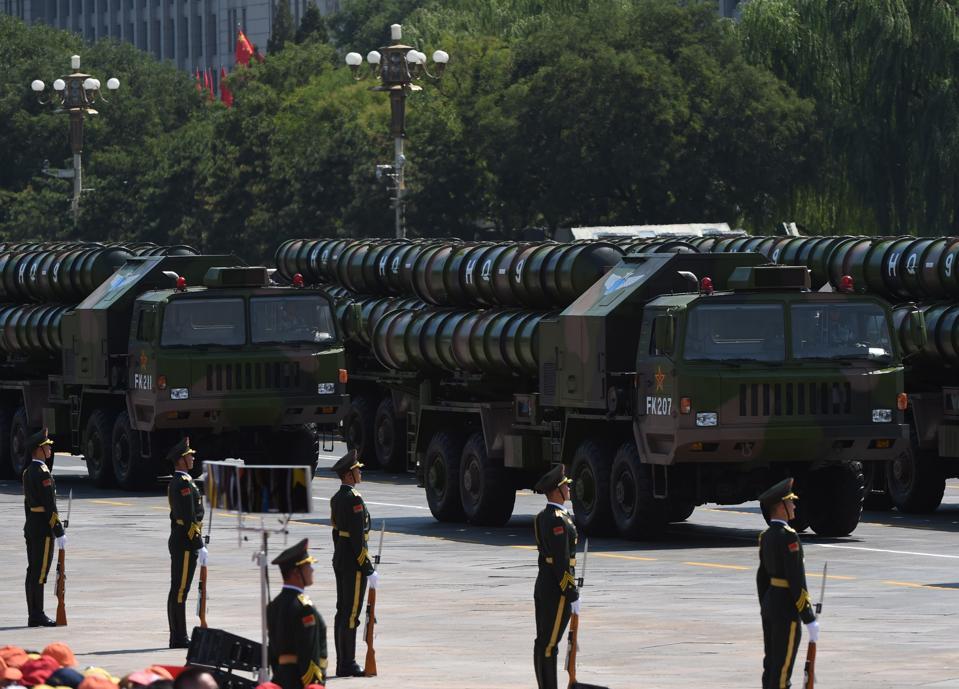
Chinese People’s Liberation Army HQ-9 surface to air missile launchers are seen during a military parade at Tiananmen Square in Beijing on September 3, 2015. (GREG BAKER/AFP via Getty Images)
AFP via Getty Images
Azerbaijan’s purported acquisition of strategic Chinese HQ-9BE surface-to-air missile systems will undoubtedly strengthen its already formidable arsenal of Russian and Israeli-made ground-based air defenses. It could also serve as another indication that Beijing is securing deals for its strategic air defenses with countries that had hitherto acquired equivalent systems from Russia.
Ahead of Azerbaijan’s military victory parade, marking the fifth anniversary of its military defeat of Armenia in Nagorno-Karabakh in 2020, in Baku on Saturday, an image circulated online of a Chinese-made HQ-9BE system driving along one of the parade routes.
Azerbaijani media correctly noted that while there are not yet any confirmations of an acquisition from officials in either Baku or Beijing, the photographed “presence in parade rehearsals strongly suggests that Azerbaijan has officially integrated the HQ-9BE into its arsenal.”
If confirmed, such an acquisition would not come as a surprise. Resource-rich Azerbaijan has invested heavily in its military over the past decade. And air defenses are certainly no exception. In the early 2010s, it acquired strategic, long-range S-300 PMU-2 missile systems from Russia. The HQ-9 is China’s equivalent of the S-300 and bears a striking resemblance to it. S-300s in Azerbaijani service participated in an air defense drill as recently as 2024.
S-300 air defense systems are displayed during the Victory Parade held to celebrate Azerbaijani army’s victory in Nagorno-Karabakh at Azadliq Square (Freedom Square) in Baku, Azerbaijan on December 10, 2020. (Photo by Mustafa Murat Kaynak/Anadolu Agency via Getty Images)
Anadolu Agency via Getty Images
Furthermore, Baku bought Russian-designed Buk-MB medium-range surface-to-air missiles from Belarus in the early 2010s.
While Moscow has long been a traditional arms supplier of Azerbaijan and its neighboring rival, Armenia, Baku has also purchased significant quantities of arms from Turkey and Israel. Doing so has diversified its sources of armaments and reduced its reliance on Moscow.
Azerbaijan acquired the Barak medium-range air defense system from Israel in the 2010s. During the 2020 war with Armenia over Nagorno-Karabakh, an Azerbaijani Barak reportedly intercepted a Russian-made Armenian Iskander short-range ballistic missile fired at Baku.
Ahead of its September 2023 conquest of the entire Karabakh region, Azerbaijan deployed a Barak system and even simulated the detection and destruction of “a ballistic missile launched by an imaginary enemy.” It did this less than a week before launching a lightning offensive against the Armenian-populated enclave that swiftly captured remaining territory outside of Azerbaijani control and caused the entire population of approximately 120,000 ethnic Armenians to flee their homes.
The purported HQ-9BE acquisition comes shortly after Azerbaijan began taking delivery of an order for 40 JF-17C Block III fighter jets from Pakistan. That acquisition alone will drastically alter the balance of air power in the South Caucasus and dwarf Armenia’s current air force, which only has four Russian Su-30SM Flanker fighter jets. Armenia has denied recent reports that it is acquiring Indian-made Su-30MKI variants as part of a multi-billion-dollar deal.
Armenia has also begun diversifying its sources of military hardware to reduce its hitherto overwhelming reliance on Russia, from which it sourced over 90 percent of its arsenal until this decade. It did so later than Azerbaijan, after its calamitous 2020 defeat at the hands of Baku. As with Azerbaijan, Armenia’s strategic ground-based air defenses consisted of Russian-supplied S-300s, specifically S-300PS variants delivered in the late 2000s and early 2010s, supplemented by short-range Tor-M1 delivered in the late 2010s.
Since 2020, it has turned to India. Aside from multiple-rocket systems and other acquisitions, it has bought India’s medium-range Akash air defense missile system. However, these engage targets at a much closer range than the S-300 or HQ-9BE, which can respectively hit targets from approximately 120 to 160 miles away. They are therefore much better suited for point defense or forming the lower tiers of a multilayered air defense.
Coupled with the large JF-17 order, even a small number of HQ-9BEs would significantly bolster an already substantial air defense. Since Pakistan collaborated with China for the design and construction of the JF-17 and also operates HQ-9Bs and other Chinese-made systems, Baku will likely have little difficulty operating these fighters and surface-to-air systems in tandem.
Aside from giving it a significantly more powerful air defense than Armenia, it also strengthens its hand vis-à-vis Iran. Successive Israeli airstrikes destroyed Tehran’s S-300s over the past year. Additionally, the Iranian air force is badly antiquated, as highlighted by the 12-day Israel-Iran war in June 2025. The modern JF-17 variant that Baku is now operating is more advanced than any of the fourth-generation fighters currently flown by Iran’s larger air force.
During a period of heightened tensions with Iran in late 2021, Azerbaijan reportedly contemplated buying Israel’s sophisticated Arrow 3 exoatmospheric anti-ballistic missile system. While significantly less advanced, the HQ-9BE is also considerably less expensive than the Arrow 3 and undoubtedly easier for Azerbaijan to independently maintain and operate. The HQ-9BE can purportedly counter “all kinds of air-breathing targets,” such as cruise missiles, and provide at least some protection against tactical ballistic missiles. It doubtlessly has a significantly more limited capability against ballistic threats than the Arrow 3.
More broadly, a confirmed export of the Chinese system to Azerbaijan is merely the latest example of China taking a significant portion of Russia’s share of the market for strategic air defense systems. It recently sold HQ-9Bs to Egypt, which had bought S-300VMs from Russia in the 2010s. Arguably, selling to Azerbaijan is more significant since it’s the first country in the South Caucasus, which Russia perceives as its backyard, to buy such an advanced system from Beijing.
For Azerbaijan, an HQ-9BE acquisition would mark merely the latest in a long line of diversified acquisitions aimed at providing it with some of the best defensive and offensive capabilities money can buy.